FELTNOVA PU Conveyor Belts

PU Conveyor Belts

Designed to support greener conveying and processing operations with efficient, reliable belt solutions.

Sustainability at FELTNOVA

At FELTNOVA, we believe that reliable conveyor belt performance and environmental responsibility should go hand in hand. We focus on improving material efficiency, reducing waste and developing durable belt solutions that support more sustainable industrial operations.

By exploring the use of recycled materials, including polyester fabrics made from recycled PET bottles, we aim to reduce dependence on virgin raw materials. Our energy-efficient conveyor and processing belts are also designed to help customers reduce power consumption and operating costs while maintaining reliable performance.

Sustainability at FELTNOVA

Recycled PET for More Sustainable Conveyor Belts

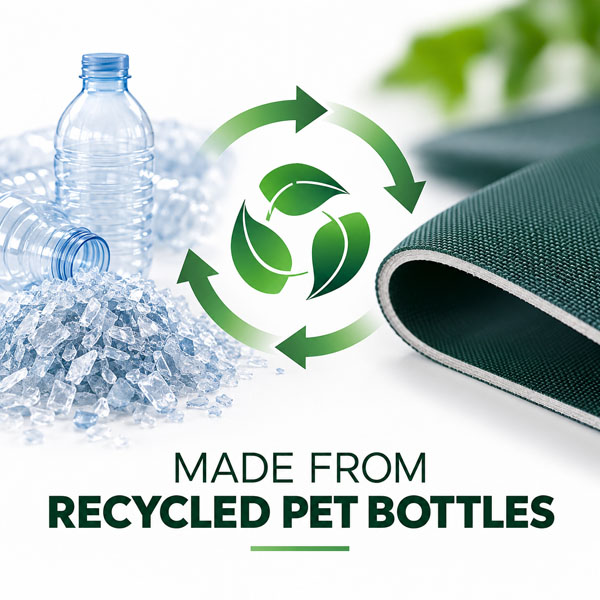
FELTNOVA is exploring new ways to make conveyor belts more resource-efficient without compromising performance. One approach is the use of recycled polyester fibers derived from PET bottles, giving existing materials a new purpose in industrial applications.

In suitable belt constructions, recycled PET can be used in the reinforcing fabric to provide strength and dimensional stability while reducing reliance on newly produced polyester. Combined with durable surface materials, this approach supports longer-lasting conveyor solutions and more responsible use of resources.

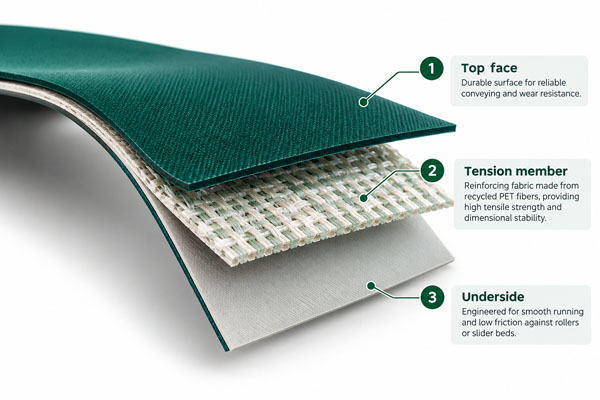
Three-Layer Conveyor Belt Construction

  • Conveying Surface – A durable outer layer designed for smooth and reliable material handling.
  • Reinforcing Fabric – The internal strength layer, which can incorporate recycled PET fibers in selected constructions.
  • Running Side – The underside engineered for stable belt movement and reduced friction against compatible conveyor components.
Recycled PET for More Sustainable Conveyor Belts

Recycled PET Reinforcement for Sustainable Conveyor Belts

Recycled PET fibers offer a more resource-conscious alternative to conventional polyester yarns in conveyor belt manufacturing. Produced from recovered plastic materials, these fibers can be woven into reinforcing fabrics that provide the strength, flexibility and dimensional stability required for industrial conveying applications.

Using recycled polyester in suitable belt constructions helps reduce the need for virgin materials and can lower the environmental impact associated with raw material production. This approach supports the development of durable conveyor and processing belts with a greater focus on sustainability.

Recycled PET Reinforcement for Sustainable Conveyor Belts

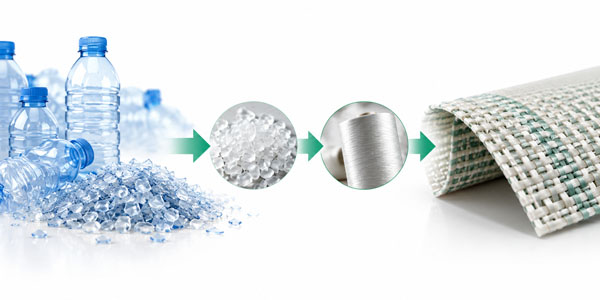
How Recycled PET Becomes Conveyor Belt Fabric

Recycled PET (rPET) is polyester recovered from used plastic products, particularly beverage bottles. Instead of relying entirely on newly manufactured polyester, rPET provides an alternative source of fibers for industrial textiles, including the reinforcing layers used in conveyor belts.

The recycling process begins with collecting and sorting used PET bottles. After removing impurities, labels and caps, the bottles are washed and broken down into small flakes. These flakes are further processed into recycled polyester material, which can then be spun into yarn.

The resulting yarns are woven into strong, flexible fabrics suitable for conveyor belt reinforcement. When incorporated into the belt's tension member, recycled polyester can provide the structural support needed for reliable conveying while helping reduce the use of virgin raw materials.

For FELTNOVA, exploring rPET-based belt constructions is one way to support more responsible material use and the development of sustainable conveyor solutions.

Sustainability is not just a trend – belts designed for the future in proven quality

As part of its sustainability strategy, FELTNOVA Movement Systems is consistently forging ahead with the development of sustainable products and services. As a result, we can offer our customers products that are made from sustainable, recycled materials and have features that verifiably enhance customers’ sustainability performance.

Our customers can choose from the Transilon ECOFIBER portfolio according to their own sustainability preferences:

Sustainability feature: belts with fabric made from recycled PET
>Benefits: Saving valuable raw materials, avoiding waste

Sustainability feature: Belts with fabric made from recycled PET and PVC made from bio-based oils from the food industry
>Benefits: Saving valuable raw materials, avoiding waste, supporting genuine recycling.

Sustainability feature: Belts with fabric made from recycled PET and special underside finish
>Benefits: Saving valuable raw materials, avoiding waste, saving electricity/costs, lower CO2 emission.

Lower carbon footprints but the quality’s the same

Using yarns made of recycled PET saves several tonnes of carbon dioxide annually. If we take just 30 of our Transilon belts, the potential annual savings are approx. 1,400 tonnes of carbon dioxide if only recycled PET yarns are used.

  • One tonne of carbon dioxide is about the volume of an eight-metre-high cube
  • To absorb one tonne of carbon dioxide, a beech tree would have to be about 80 years old
  • One tonne of carbon dioxide is equivalent to driving a mid-range car for 4,900 kilometers


    (Source: tagesschau.de)

Dr. Torsten Buch, vice president of the Transilon/Transtex product line, managing director of Feltnova GmbH, comments on the quality of Transilon ECOFIBER:

“All our lab and field tests show that yarns made of secondary raw materials perform just as well as the yarns previously used. Conveyor and processing belts with tension members made of recycled PET are identical to the quality of belts with tension members made of new PET. They’re equally stable and their breaking and tensile strength, as well as thermal stability, make them ideal for producing tension members.

We’ve been applying conventional PET to make belts for decades. By using recycled PET, both we and our customers (who operate these belts) are saving valuable resources. And the clever part is that the quality’s the same. Recycled PET takes us a step further to a circular economy.”

Dr. Torsten Buch

Let’s talk about developing a sustainable strategy for the future together

We’re sure you’re interested in getting your company in shape for the challenges of a society and environment that have changed. And that you want to develop a strategy for the future that’s sustainable and supported by your own customers too. We’d like to offer you the opportunity to talk to our experts about the future. Let’s develop specific areas to tackle together. Contact us to discuss your ideas for making your business more sustainable.

Further Information

127 EN – Transilon Ecofiber

Transilon ECOFIBER

The conveyor belt for sustainable conveying

DOWNLOAD