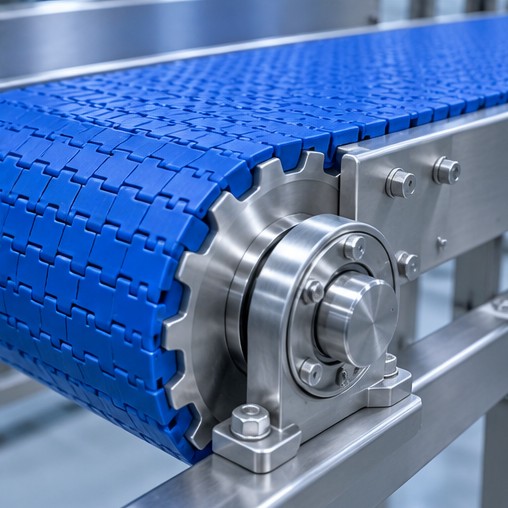
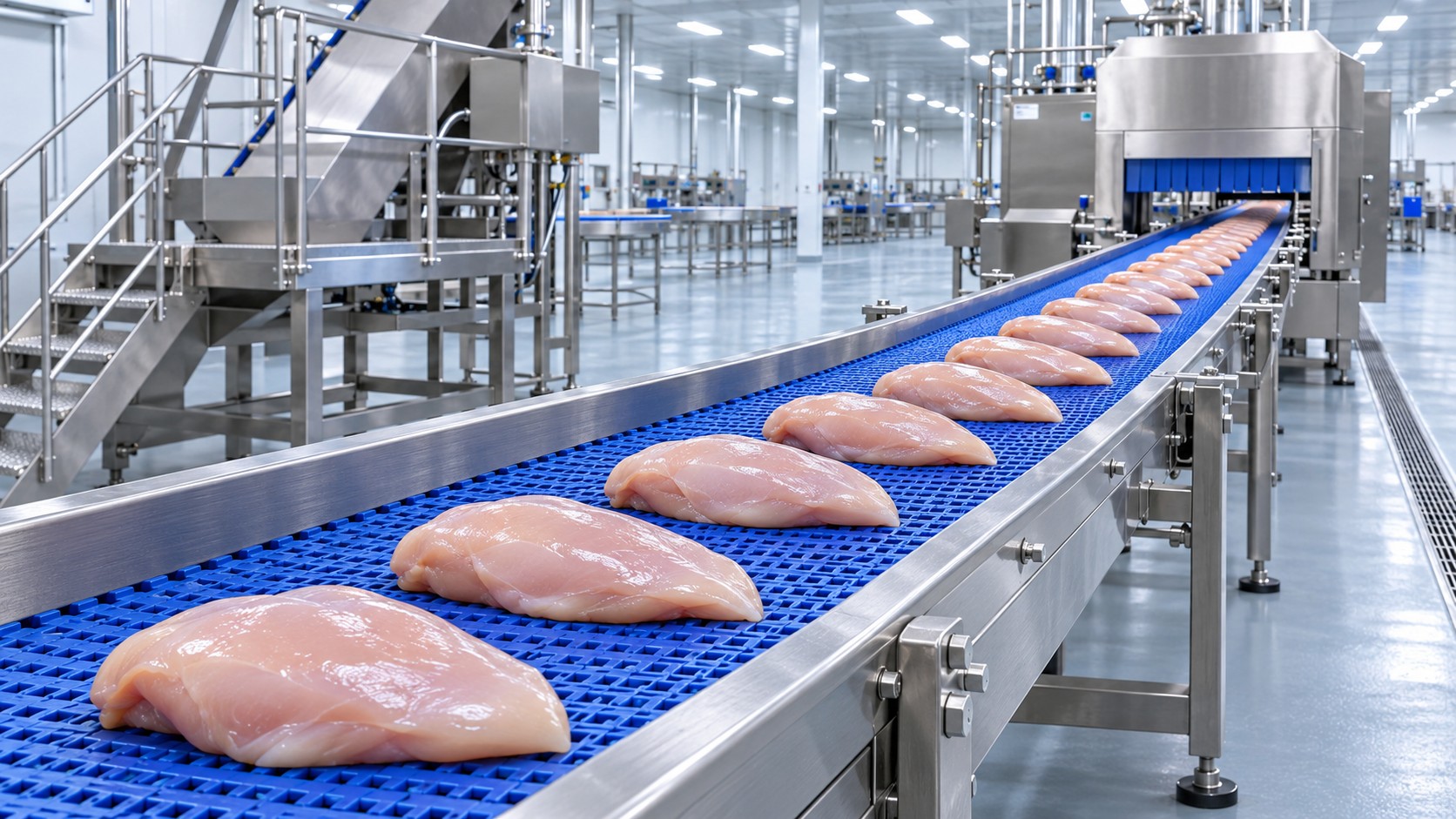
1. Receiving and primary processing
Conveyors connect receiving, primary processing and by-product handling. Keep these zones separate so that belt selection and washdown procedures reflect the hygiene risks of each task.
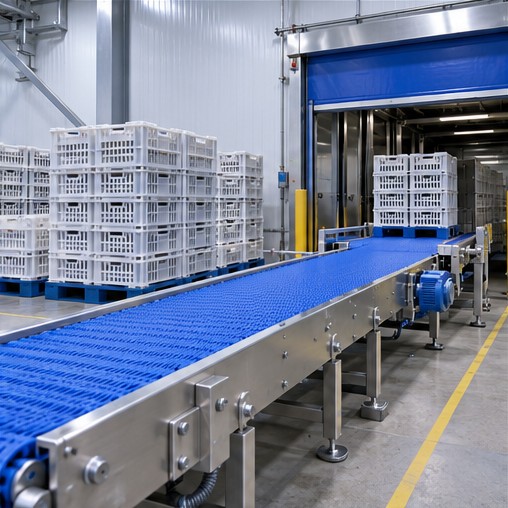
Belt requirements
Receiving belts need to withstand repeated loading, abrasion and the cleaning chemicals used on site. Belts in contact with edible products require suitable food-contact documentation and accessible cleaning surfaces.
The Feltnova approach
Feltnova can help assess robust modular belts for receiving and easy-clean belt constructions for downstream handling. Specify the load, conveyor geometry and sanitation regime before choosing the material.
2. Skinning, deboning and cutting
Stable product support helps operators and automated equipment position poultry accurately during skinning, deboning and cutting. Smooth transfers reduce unnecessary handling between stations.
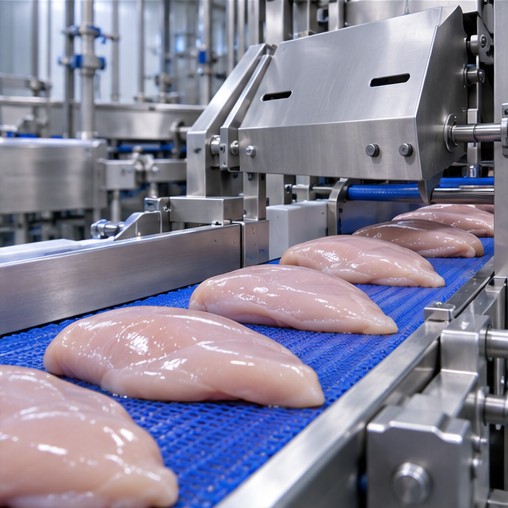
Belt requirements
Choose a surface appropriate to the cutting method, with enough grip to control the product. Review resistance to scoring, belt support, transfer diameter and access for daily inspection.
The Feltnova approach
Compare Feltnova modular and polyurethane belt options against the actual cutting process. Where fabric-based belts are used, suitable edge finishing and splice design can help reduce exposed fabric and simplify cleaning.
3. Dip tank conveying
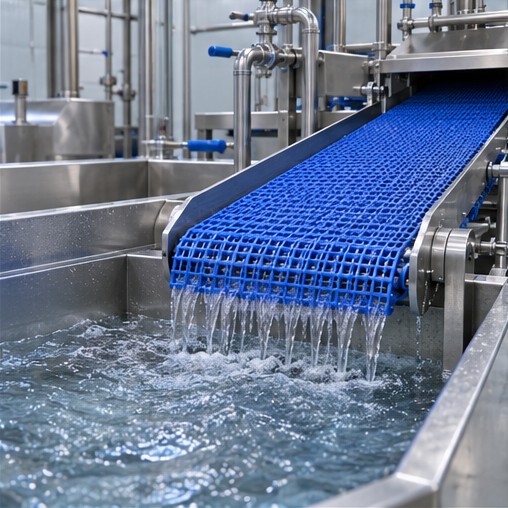
Dip conveyors carry products through water-based treatment or cooling stages. The belt must support the product while allowing the required flow and drainage.
Belt requirements
Check immersion temperature, treatment chemistry, dwell time and buoyancy. Open area, hinge design and belt support should suit the product size and the tank layout.
The Feltnova approach
Feltnova helps match open modular belt designs and materials to the tank conditions. Flights or retaining features can be considered where needed; confirm compatibility with the treatment medium before installation.
4. X-ray inspection
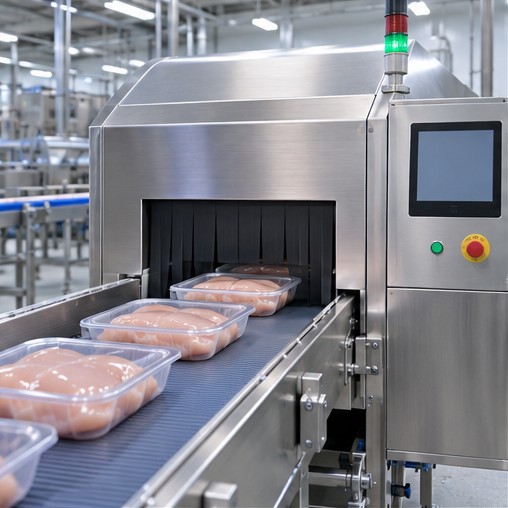
A steady, evenly presented product stream supports reliable X-ray inspection. The conveyor should preserve spacing as portions or trays enter and leave the inspection unit.
Belt requirements
Belt construction must be compatible with the equipment supplier’s inspection settings. Consistent thickness, stable tracking and clean transfers help avoid variation in product presentation.
The Feltnova approach
Discuss Feltnova belt options with the inspection-system supplier. Validate the selected belt using representative products, pack formats and test pieces as part of the line’s inspection procedure.
5. Marinating and product finishing
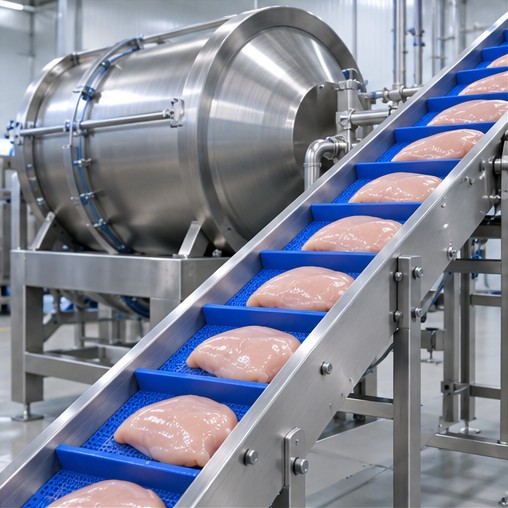
Finishing lines move poultry through marinating, seasoning and related preparation steps. Controlled conveying helps maintain product orientation and manage excess liquid.
Belt requirements
Assess exposure to oils, salt, acids and cleaning agents. Surface release, drainage and incline grip must be balanced against gentle handling and ease of cleaning.
The Feltnova approach
Feltnova can help compare smooth, textured and open belt designs for your finishing process. Select flights and sidewalls only where they suit the product flow and remain accessible for sanitation.
6. Freezing and cold conveying
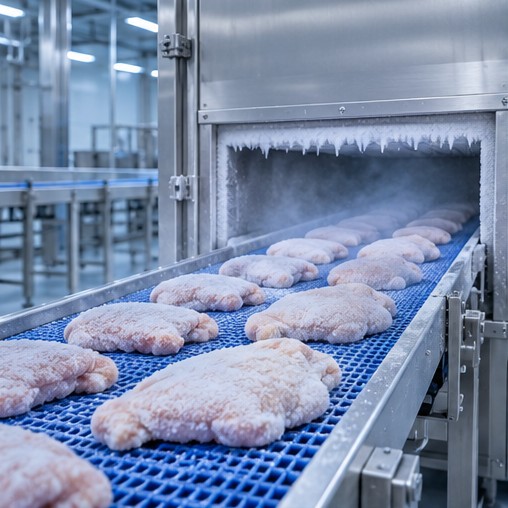
Freezer conveyors move portions through cold environments and transfer frozen products to the next stage. The belt must operate through both production and defrost cycles.
Belt requirements
Verify the minimum operating temperature, thermal movement and material flexibility. Open area, airflow, belt support and ice build-up all affect conveyor performance.
The Feltnova approach
Choose Feltnova belt materials against the full temperature cycle and conveyor design. Review sprocket engagement, clearances and transfer points with the freezer supplier before specifying the belt.
7. Portioning and transfer
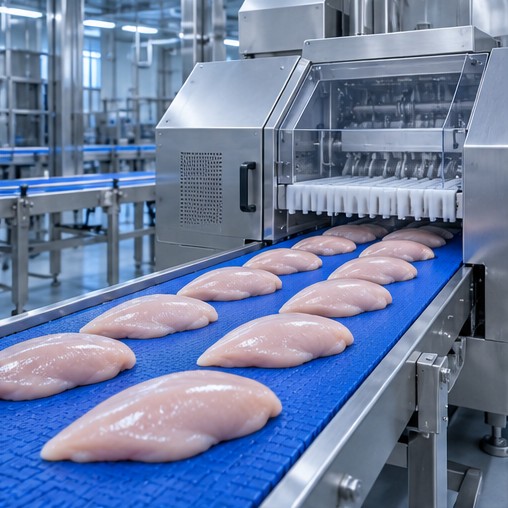
Accurate portioning depends on repeatable product positioning and controlled transfers. Belts link cutting, weighing and tray-loading equipment while limiting disturbance to delicate portions.
Belt requirements
Check belt speed stability, surface grip, tracking and the smallest transfer diameter. Select a surface suited to direct product contact and to the cleaning method used between production runs.
The Feltnova approach
Feltnova helps assess thin fabric-based or homogeneous belts where compact transfers are needed, alongside modular designs for suitable layouts. Confirm belt tension and splice construction with the machine supplier.
8. Checkweighing
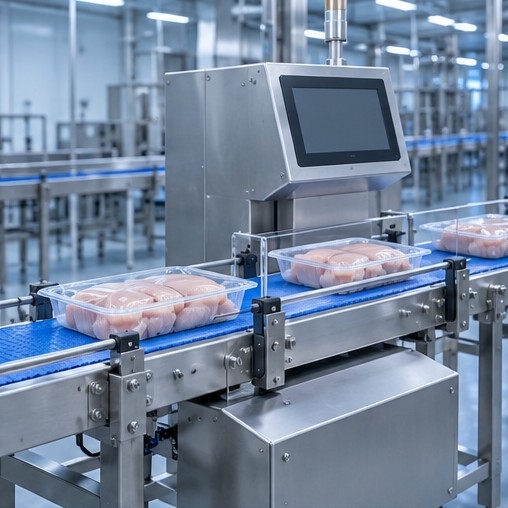
Checkweighers verify individual portions or packs at production speed. A consistent conveyor handover helps the weighing system measure each item under repeatable conditions.
Belt requirements
The belt must track smoothly and run with minimal vibration. Belt mass, splice uniformity, product spacing and the surrounding conveyor arrangement should follow the checkweigher manufacturer’s requirements.
The Feltnova approach
Feltnova can support belt selection for compact weighing conveyors. Trial the chosen construction at normal line speed and verify weighing accuracy with the site’s established calibration and test procedures.
9. Metal detection
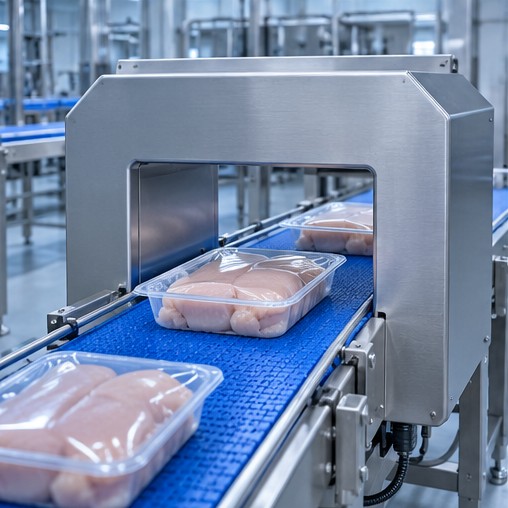
Metal-detection conveyors present products to an inspection aperture before release or packing. Belt selection forms one part of a complete, validated detection system.
Belt requirements
Confirm belt suitability with the detector manufacturer. Review material composition, static behaviour, belt cleanliness and any joints or fasteners that may affect the inspection zone.
The Feltnova approach
Feltnova can help identify belt constructions for review by your detector supplier. Verify detection and rejection performance with the actual product, belt and operating conditions; no belt alone guarantees detection sensitivity.
10. Final packaging
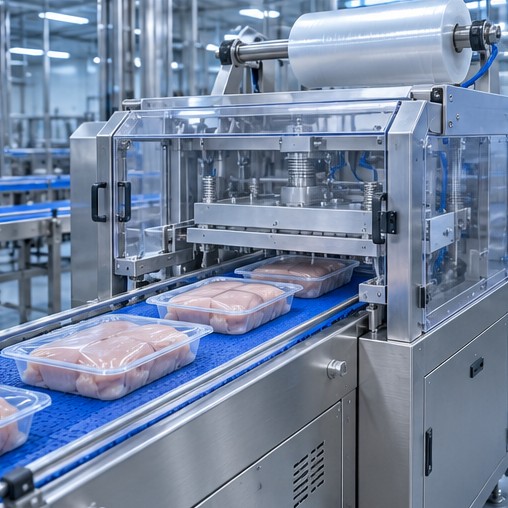
Packaging conveyors carry portions and finished trays through sealing, labelling and dispatch preparation. Reliable transfers help keep packs aligned and reduce interruptions between machines.
Belt requirements
Match belt grip and release to the pack format. Consider moisture, cleaning access, accumulation, transfer gaps and speed changes across the packaging line.
The Feltnova approach
Feltnova helps select conveying surfaces and belt constructions for tray handling and packaged poultry. Share the pack dimensions, weight and line layout so transfer details can be reviewed before commissioning.